Is Excessive Vitamin C Supplementation Better for Health? Replace Blind "Nutritional Guesswork" with a Scientific "Genetic Map"
In recent years, rumors claiming that daily megadoses of vitamin C can boost human immunity or even inhibit the proliferation of cancer cells have intensified. Many industry insiders in healthcare and related fields have posted online, sharing that after taking large doses of vitamin C long-term, they felt an "enhanced physique" and were "less prone to colds," earning widespread praise and agreement from users. At the same time, however, many medical experts and doctors have voiced opinions stating that high-dose vitamin C supplementation offers no extra benefits to the human body; on the contrary, long-term excessive intake may trigger gastrointestinal discomfort, kidney stones, and other symptoms. These contradictory viewpoints often leave people trapped in confusion regarding nutrient supplementation.
Can long-term, high-dose oral vitamin C really deliver the rumored benefits?
Modern medicine holds that excessive vitamin supplementation does not bring additional health benefits. Research indicates that only in populations subjected to prolonged extreme physical exertion or cold environments might vitamin C supplementation slightly shorten the duration of a cold. For ordinary people, it shows no significant preventive or therapeutic effect. Furthermore, oral megadoses of vitamin C do not improve the survival rate or symptoms of cancer patients. In addition, vitamin C is water-soluble, and its absorption by the human small intestine relies on a transport carrier called SVCT1. This carrier saturates very easily: when a single intake exceeds 200–400 mg, the intestinal absorption rate drops significantly; when intake exceeds 1000 mg, the absorption rate plummets below 50%, with the vast majority of the excess excreted directly via urine.
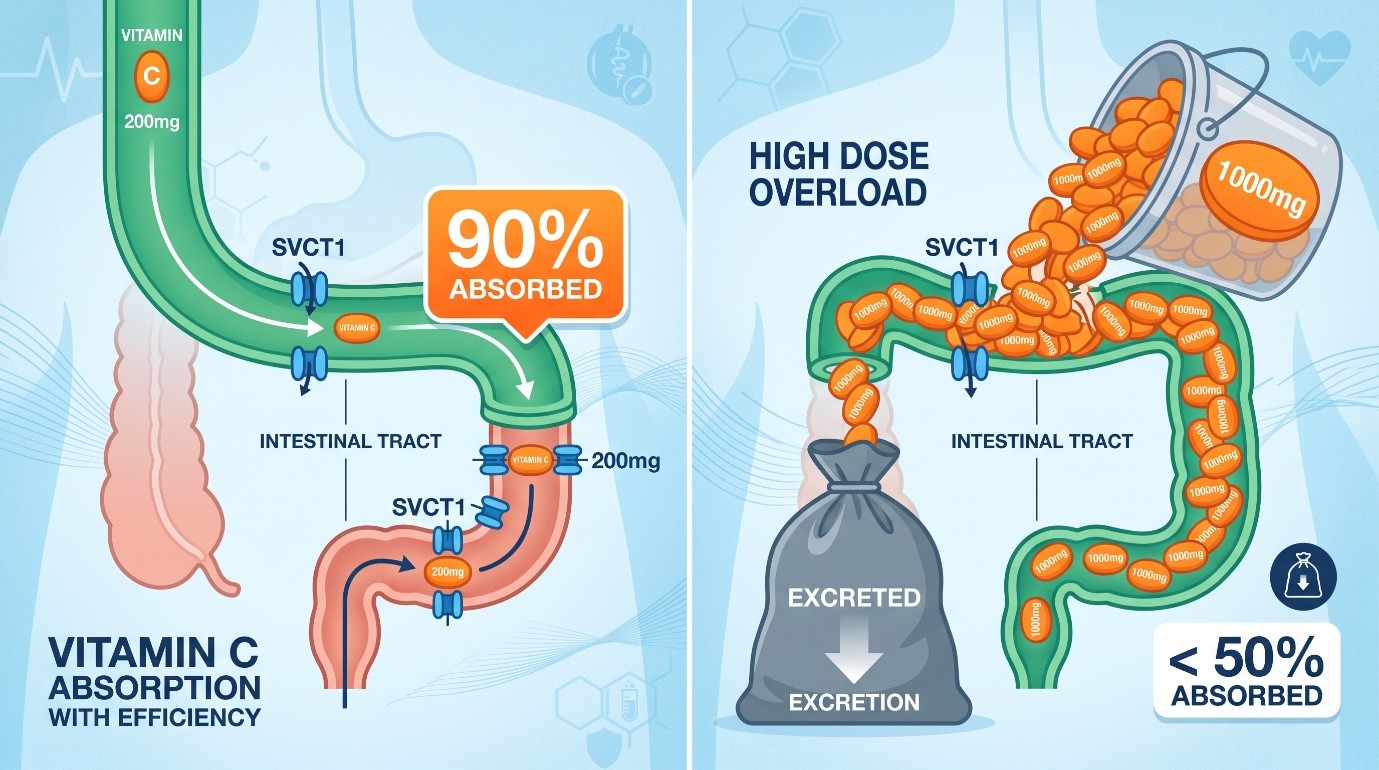
Although many brands have introduced "sustained-release" vitamin C, these can only improve overall absorption and utilization to a certain extent while easing the gastrointestinal irritation caused by ordinary high-dose tablets; they still cannot break through the physiological limit of human vitamin absorption.
So Why Have Myths About Vitamin C Spread So Widely?
The rumor that "high-dose vitamin C supplementation can fight cancer" mainly originated from the promotion by a famous scientist in the 1970s. It was later amplified by the health supplement market and mass media, evolving into an urban legend that persists to this day.
Linus Pauling was the primary driver behind this rumor. He was an extremely rare, legendary scientist in history who won two unshared Nobel Prizes (Chemistry and Peace). In his later years, however, he developed an almost obsessive fascination with vitamin C, advocating daily doses of several grams or even tens of grams, claiming it could cure colds, delay aging, and combat cancer. Due to his immense academic authority, his views quickly garnered worldwide attention.
Pauling was also a close friend of the famous Chinese scientist Qian Xuesen. After Pauling shared his philosophy with Qian, Qian firmly believed in it, going so far as to ignore his doctors' objections and persist in taking vitamins at doses over a hundred times higher than normal for the long term. Ultimately, Qian's longevity—living to 98—and his active mind in his later years seemed to offer yet another piece of evidence for this view, becoming a promotional pillar for many supplement manufacturers. However, America's famous Mayo Clinic attempted early on to replicate Pauling's experiments, and the results demonstrated that his theory could not pass rigorous double-blind, randomized controlled trials.
What Are the Primary Risks of Long-Term High-Dose Vitamin C Intake?

The recommended daily intake of vitamin C is only 90–100 mg per day, whereas doses recommended by many supplement merchants and bloggers commonly reach or exceed 1000–2000 mg per day.
When high doses of vitamin C are taken orally over a long period, it metabolizes in the body into oxalic acid. This can lead to excessively high concentrations of oxalic acid in urine, significantly increasing the probability of kidney stone formation. Moreover, high concentrations of ascorbic acid repeatedly irritate the gastrointestinal mucosa, causing various digestive conditions such as gastric ulcers. Vitamin C also significantly promotes the absorption of non-heme iron from food; long-term excess may lead to iron accumulation in the body, increasing toxicity to the liver and heart. This demonstrates that to achieve good absorption without harming the body, we need a more accurate intake standard.
Do Recommended Daily Vitamin C Intakes Differ for Healthy People? How Should You Choose the Right Daily Intake for Yourself?
Recommended daily vitamin C intake indeed varies among healthy individuals. Common lifestyle factors influencing this include age, gender, physiological state, and personal lifestyle habits. Beyond these, differences in genotype exert a very significant impact on the body's ability to absorb and utilize micronutrients (minerals and vitamins).

Modern nutrigenomics research has revealed that due to gene mutations or SNPs, different people taking the same dose of vitamin C can experience vastly different actual absorption outcomes and plasma concentrations. Among the most influential factors are differences in transporter genes (SLC23A1 and SLC23A2), which code for the body's sodium-dependent vitamin C transporters (SVCT1 and SVCT2). SVCT1 is responsible for absorbing vitamin C in the intestines and reabsorbing it in the kidneys to prevent loss through urine; SVCT2 transports vitamin C to vital organs such as the brain and eyes. If specific locus mutations exist in the SLC23A1 gene, transporter protein efficiency drops. This leaves the kidneys unable to "retain" vitamin C, causing it to be excreted through urine much faster or resulting in lower intestinal absorption rates.
Similarly, from entering the gut to being utilized by the body, various micronutrients besides vitamin C rely on a series of gene-coded transporter proteins, receptors, metabolic enzymes, and binding proteins. Single nucleotide polymorphisms (SNPs) or mutations in these related genes directly alter the structure or quantity of these proteins. Consequently, individuals on the exact same diet can end up with massive differences in their internal micronutrient levels. This explains why some people maintain a healthy diet long-term and take supplements according to guidelines, yet still receive medical checkup results indicating a deficiency in a specific micronutrient.
Recommended Micronutrient Intake Requires "Personal Tailoring"
iNutrigen is a personalized precision nutrition testing and analysis service combining nutrigenomics with artificial intelligence, launched by the Hong Kong biotechnology company Decode Cure Limited.

Its core philosophy aligns with what we discussed earlier: "genes dictate that each individual absorbs, metabolizes, and consumes nutrients at different rates; therefore, no universal supplementation plan works for everyone." Therefore, iNutrigen performs genetic sequencing on buccal swab samples to focus on monitoring key gene loci (SNPs) associated with vitamins (e.g., Vit C, Vit D, B-complex, etc.), microelements (e.g., iron, zinc, calcium, selenium, etc.), lipid metabolism (e.g., Omega-3/6), and antioxidant/detoxification capabilities (e.g., the Glutathione system). Combined with Decode Cure's proprietary big data analysis platform, it cross-references individual genotypic traits against the latest clinical research databases to evaluate a test subject's "high/low absorption rate," "high/low consumption rate," and "potential risk of deficiency" across various nutrients.
While average consumers often purchase high-dose vitamins or minerals based on advertisements or gut feelings—which is not only wasteful but potentially counterproductive—iNutrigen accurately identifies your genetic transport defects to break away from "one-size-fits-all" approaches, achieving truly efficient and precision supplementation. Furthermore, the genetic testing chips and algorithms used by Decode Cure rely on solid bioinformatics and medical data, avoiding the pitfalls of many "entertainment-grade" genetic tests on the market that produce overly vague results lacking clinical guidance value. For populations who often feel fatigued, have specific family medical histories, or have taken numerous supplements long-term with little result, this type of nutrigenomic analysis can help establish a lifelong precision nutrition strategy built uniquely for the individual.
Note: iNutrigen provides nutritional and micronutrient supplementation recommendations only and cannot serve as a clinical diagnostic standard. If you experience physical discomfort or symptoms, please seek professional medical guidance promptly.
1. Padayatty SJ, Sun H, Wang Y, Riordan HD, Hewitt SM, Katz A, Wesley RA, Levine M. Vitamin C pharmacokinetics: implications for oral and intravenous use. Ann Intern Med. 2004 Apr 6;140(7):533-7. doi: 10.7326/0003-4819-140-7-200404060-00010. PMID: 15068981.
2. Creagan ET, Moertel CG, O'Fallon JR, Schutt AJ, O'Connell MJ, Rubin J, Frytak S. Failure of high-dose vitamin C (ascorbic acid) therapy to benefit patients with advanced cancer. A controlled trial. N Engl J Med. 1979 Sep 27;301(13):687-90. doi: 10.1056/NEJM197909273011303. PMID: 384241.
3. Tsukaguchi H, Tokui T, Mackenzie B, Berger UV, Chen XZ, Wang Y, Brubaker RF, Hediger MA. A family of mammalian Na+-dependent L-ascorbic acid transporters. Nature. 1999 May 6;399(6731):70-5. doi: 10.1038/19986. PMID: 10331392.
4. Timpson NJ, Forouhi NG, Brion MJ, Harbord RM, Cook DG, Johnson P, McConnachie A, Morris RW, Rodriguez S, Luan J, Ebrahim S, Padmanabhan S, Watt G, Bruckdorfer KR, Wareham NJ, Whincup PH, Chanock S, Sattar N, Lawlor DA, Davey Smith G. Genetic variation at the SLC23A1 locus is associated with circulating concentrations of L-ascorbic acid (vitamin C): evidence from 5 independent studies with >15,000 participants. Am J Clin Nutr. 2010 Aug;92(2):375-82. doi: 10.3945/ajcn.2010.29438. Epub 2010 Jun 2. Erratum in: Am J Clin Nutr. 2013 Jul;98(1):253-4. PMID: 20519558; PMCID: PMC3605792.