Gastrointestinal Health from the Oral Cavity: Beware of "Health Signals" Sent by Digestive System Diseases
With modern diets becoming increasingly complex, oral problems follow one after another. Among them, periodontitis is not only a chronic infectious disease confined to the oral cavity, but also one of the "epicenters" of systemic, multi-system chronic inflammation. Oral bacteria are the main cause driving these health problems and can reflect the health status of the digestive system at a deeper level.

The oral cavity is one of the environments with the highest microbial density and complexity in the human body (containing hundreds of types of bacteria). Bacteria in the mouth are not simply scattered food residue; they secrete polysaccharide substances to form an extremely sturdy protective shield—the "dental plaque biofilm," which is also a tightly structured, constantly growing, and evolving bacterial ecological community.
There is a significant bidirectional interactive relationship between oral bacteria and various digestive system diseases: periodontal pathogens and their metabolites in the mouth can directly or indirectly affect the functions of digestive organs such as the stomach, intestines, liver, and pancreas via two pathways: "swallowing through the digestive tract" and "blood circulation dissemination".
Therefore, as long as we master the bacterial code of dental plaque, we possess a "monitor" to comprehensively understand our physical health and efficiently and conveniently receive "health signals" sent by digestive system diseases.
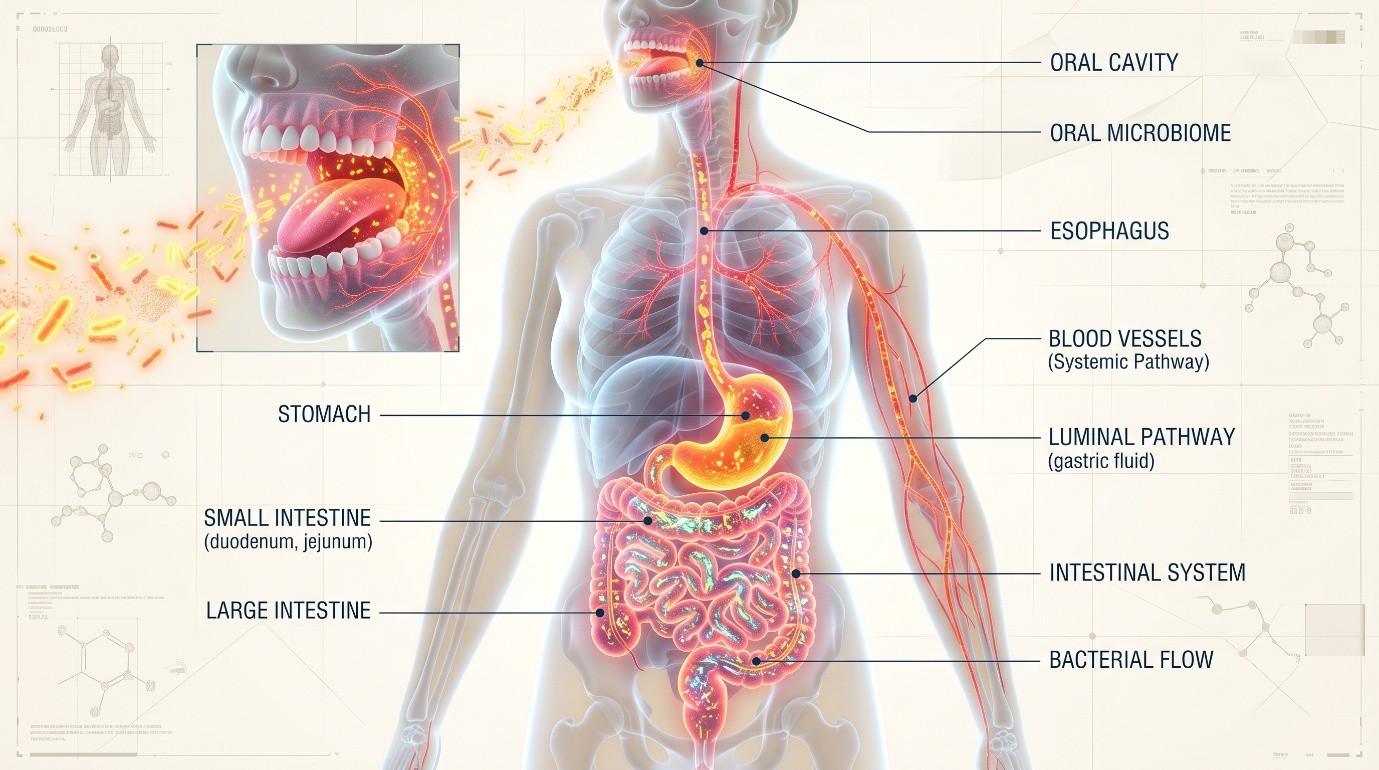
Regarding the relationship between oral bacteria and the digestive system, the most widely known is Helicobacter pylori (H. pylori), a Class I carcinogen. It is a key pathogenic factor causing a variety of upper gastrointestinal diseases, and almost all infected individuals develop varying degrees of chronic gastric mucosal inflammation.
According to the authoritative medical journal Gastroenterology and global epidemiological analyses by the World Health Organization (WHO), the global infection rate of Helicobacter pylori is approximately 43.1% to 50%, involving about 3.5 billion to 4.4 billion people. In China, the infection rate of Helicobacter pylori is around 40% to 50%. Due to the incomplete adoption of separate dining, the sharing of utensils, and habits such as kissing or feeding children with pre-chewed food, Helicobacter pylori demonstrates a high degree of "family aggregation"—with family infection rates reaching up to around 70%.
In recent years, Helicobacter pylori has continuously gained attention through extensive medical publicity, and people who often experience gastrointestinal discomfort choose the C13/C14 urea breath test to determine whether an H. pylori infection exists in the stomach. However, Helicobacter pylori does not exist solely in the stomach.
An anaerobic zone is formed deep within dental plaque and inside periodontal pockets, which is very suitable for the survival of anaerobic or microaerophilic microorganisms like Helicobacter pylori. Due to the stable structure of dental plaque, bacteria attached to it can achieve long-term colonization.
When some patients take quadruple therapy (acid suppressants + bismuth + two antibiotics) to treat gastric Helicobacter pylori, the drug components can penetrate the gastric mucosa well, but it is extremely difficult for them to penetrate the sturdy extracellular polymeric substance (EPS) barrier of dental plaque. Oral Helicobacter pylori manages to "survive" here. Helicobacter pylori hidden in dental plaque and periodontal pockets are not killed by the medication. As saliva or food is swallowed, bacteria in the mouth travel downstream into the stomach again, leading to recurrent gastric Helicobacter pylori reinfection.

In addition to Helicobacter pylori, there are many other harmful bacteria that exist in both the oral cavity and the digestive tract, which to a certain extent reflect and affect human gastrointestinal health, yet lack equally mature detection methods. Routine blood and stool tests usually do not include specific harmful bacteria detection, and some bacteria affected by gastric acid and digestive juices may not be accurately marked in stool. Serum antibody tests cannot distinguish whether a bacterial infection is current or cured, only representing that one has been "infected before".
Clearly, we need a more convenient and precise target to monitor pathogenic bacteria in the body—and dental plaque is precisely an excellent non-invasive detection window. Dental plaque sampling is completely non-invasive, painless, and has extremely high patient compliance. More importantly, because dental plaque is an "outpost colonization site" for pathogenic bacteria such as Helicobacter pylori and Fusobacterium nucleatum, it can issue early warning signals of dysbiosis before severe organic lesions (such as ulcers and tumors) appear in the gastrointestinal tract.

RisCAP-GI is a dental plaque pathogen (pathogenic bacteria) genetic testing product developed by Decode Cure Limited in Hong Kong, expanding the original RisCAP technical architecture to the digestive system. This is Decode Cure's precise gastrointestinal/digestive tract pathogen genetic testing solution addressing digestive issues, utilizing its third-generation gene sequencing, proprietary pathogen enrichment technology, and big data bioinformatics analysis platform.
Traditional digestive tract pathogen testing (such as stool/vomitus bacterial culture, smear microscopy, and rapid immune antigen tests) suffers from limitations such as being time-consuming (3–5 days), having low detection rates (especially for hard-to-culture viruses and anaerobic bacteria), and being unable to simultaneously detect multi-mixed infections. In response, RisCAP-GI focuses on pathogen detection in dental plaque, adopting proprietary host de-noising and pathogen enrichment technology. It can accurately capture trace pathogenic bacterial genes amidst a massive cellular background like a "magnifying glass," overcoming the drawback of missed detections common in ordinary sequencing, and offering the advantages of being "fast, broad-spectrum, and highly sensitive".
Through this report, you can not only understand whether your oral environment is suffering from attacks by harmful bacteria, but also intuitively comprehend the potential damage these harmful bacteria may cause to the digestive system and associated disease risks, establishing an early warning system to "prevent illness before it occurs". It provides high-value reference information for clinicians to assist in precise medication and personalized interventions.
Applying RisCAP-GI, a highly sensitive precise genetic testing platform, to dental plaque sampling essentially combines the convenience of "non-invasive oral sampling" perfectly with the extreme sensitivity of "third-generation gene sequencing + pathogen enrichment". It not only helps stomatology resolve stubborn periodontal diseases, but also serves as an outpost warning tool for gastroenterology and gastrointestinal tumor risk assessment, truly achieving "starting from the mouth to warn of gastrointestinal health".

Note: RisCAP-GI only provides test results and recommendations targeting the sample and cannot serve as a clinical diagnostic standard. If uncomfortable symptoms occur, it is recommended to seek professional clinical diagnosis from a doctor as soon as possible.
References
1. Hooi JKY, Lai WY, Ng WK, Suen MMY, Underwood FE, Tanyingoh D, Malfertheiner P, Graham DY, Wong VWS, Wu JCY, Chan FKL, Sung JJY, Kaplan GG, Ng SC. Global Prevalence of Helicobacter pylori Infection: Systematic Review and Meta-Analysis. Gastroenterology. 2017 Aug;153(2):420-429. doi:10.1053/j.gastro.2017.04.022. Epub 2017 Apr 27. PMID: 28456631.
2. Al Sayed A, Anand PS, Kamath KP, Patil S, Preethanath RS, Anil S. Oral Cavity as an Extragastric Reservoir of Helicobacter pylori. ISRN Gastroenterol. 2014 Feb 20;2014:261369. doi: 10.1155/2014/261369. PMID: 24701355; PMCID: PMC3950549.
3. Rubinstein MR, Wang X, Liu W, Hao Y, Cai G, Han YW. Fusobacterium nucleatum promotes colorectal carcinogenesis by modulating E-cadherin/β-catenin signaling via its FadA adhesin. Cell Host Microbe. 2013 Aug 14;14(2):195-206. doi: 10.1016/j.chom.2013.07.012. PMID: 23954158; PMCID: PMC3770529.
4. Harrandah AM. The Oral-Gut-Systemic Axis: Emerging Insights into Periodontitis, Microbiota Dysbiosis, and Systemic Disease Interplay. Diagnostics (Basel). 2025 Nov 3;15(21):2784. doi: 10.3390/diagnostics15212784. PMID: 41226077; PMCID: PMC12609195.